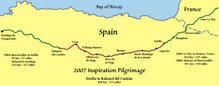
05 July 2007

Nájera-Santo Domingo de la Calzada

Day four — 21.3 kms


This was a short day for which we were glad because it got so hot in the middle of the day and we were walking through an endless new burb. More on that later.

First thing in the morning was climbing uphill out of the Nájera downtown over the ridge that separated it from the ever-closer alteplano (though we were not nearly there). On the other side of the ridge, we walked past vineyards interspersed with poppies. We also started going by big cement irrigation channels that ran alongside the vineyards.


Compa took this wonderful photo of the poppies that grow between the rows of vines. The soil here is so, so red.


Unlike some of the walking the Chemin de Saint Jacques in France where we went up and down in river valleys and never had a sense of where we were going, more often than not, we had a very clear idea of where we were headed — usually quite far away. This vista was one of those 'onwards' shots, where we knew that we would follow that white ribbon for as far as the eye could see and then some. Oh my, look at all that WHEAT (as I wrote in my journal: 'nice landscape, rolling hills, wheat and wheat and wheat!')


Noon found us climbing up a hill to a golf course/high income suburb development, Ciruñuela. The heat was brutal and there were NO trees anywhere for shade. There didn't seen to be any place to eat either. We had a few things to eat but what we really, really wanted was a cold beer. Once we passed through this empty construction site that looked as though it could house 10.000 people, we landed on a small local village, totally eclipsed by the growth. There, we found the local bar-restaurant and while the food was a bit greasy, it had cold beer and free internet. It was from here that I sent this posting. I shared the space with a Frenchman. I really couldn't see what I was doing and being a Mac user, I am always at a disadvantage with a PC, so I had to ask for a little help.

A word about the white shirt. It was brutally hot that day and the sun shone brightly. From that day on, I no longer wore short-sleeve shirts but wore a light-weight white cotton shirt to protect my skin from the sun. At that, even with SPF 35 on my hands, they got burned and tanned. I upped the lotion to SPF 50 and still I burned and tanned. So the shirt seemed a small sacrifice in the comfort zone to stay a bit more healthy in the long, long run.


Finally, we got to Santo Domingo de la Calzada, known for its holy chickens. The story is one of those crazy medieval ones that has now stuck.

Dana Facaros and Michael Pauls in the Cadogan Guide to Northern Spain write of the holy chickens in their Gothic cathedral:

'The Gothic interior is simple but lavishly decorated, but what everyone remembers best are the rooster and hen, cackling in their own late-Gothic henhouse. Their presence recalls the miracle that took place in Santo Domingo's hostal: a handsome 18-year-old German pilgrim, named Hugonell, travelling with his parents, refused the advances of the maid, who avenged herself by planting a silver goblet in his pack and accusing him of theft. Hugonell was summarily hanged by the judge while his parents sadly continued Compostela. On the way back, they passed the gallows and were amazed to find their son still alive and glad to see them, telling them it was a miracle of Santo Domingo. They hurried to the judge and told him; the judge, about to dig into a pair of roast fowl, laughed and said their son was as alive as the birds on his table, upon which both came to life and flew away. Since then, a white hen and rooster have been kept in the church, and are replaced every month; pilgrims would take one of their feathers and stick in it their hats for good luck. Under the window you can even see a piece of the gallows (138).'

The administration doesn't allow photos inside the cathedral but the image I grabbed from the web shows the glorified henhouse well. There are other treasures in the cathedral, too: a beautiful 12th-century Madonna and child behind the high altar in a nice and simple chapel. The 16th-century tomb of Santo Domingo is also amazing: a two-storey affair, one can look down into the crypt to the lower level of the tomb which also serves as a small chapel.

Kerry Egan writes of this in her Fumbling,

'The Holy Chickens made me very happy, almost irrationally happy. They seemed to make everyone happy. In the stores in town, a dozen different postcards with the images of the chickens could be found. Some were taken from a distance, with the entire chicken coop edifice on golden display, and some were close-ups of the chickens' faces in profile, like 1930's movie stars. I sent out a dozen postcards.

'While walking the Camino, I just accepted that chickens would live in a cathedral. At that point, it seemed as reasonable as a woman who used an attack dog to alert her to pilgrims passing or the wine fountain in Irache…. Chickens in a church were par for the course at that point. When I got back, all those people who received chicken postcards were baffled...' (126-27).

04 July 2007

Logroño-Nájera

Day 3 — 29.5 kms

A word about the distances: what I post is the 'official' distance. It doesn't include the walking one does once one arrives at one's destination. That walking can include going an extra km trying to find the night's lodgings, any touring one might do after showering and then wandering around. In Nájera, we probably added an additional 2 km to our official walk. One has to wonder about the logic: we spend all day on our feet and then we willingly go and walk some more? But when feet are all there is for transportation, there's no choice.

The morning saw us leaving the city of Logroño, going out through new suburbs and buildings and not the dismal garbage heaps that the guides had advertised. For a good hour or more, we enjoyed walking through a huge park, complete with lake. The signs are new, a stylised shell. We followed them through Logroño and its outskirts, past vineyards until we came up to a highway. I didn't take a photo but the fence that separates the highway from the camino is completely covered with simple wooden crosses that pilgrims have stuck into the chainlink fence. The overall effect was overpowering. From my journal: 'There were hundreds if not thousands of crosses other pilgrims had stuck in the fence. The overall effect was that of a giant weaving, a huge tela. The supply is inexhaustable because there's a wood mill nearby. I am still not quite sure what I felt seeing it.'

We stopped in the next town, Navarette, for an early lunch (at 11.30) of fried eggs, frites, bread and wine/beer. We have found that that sort of lunch sticks to the ribs and helps one walk.


The next segment was utterly dismal. The camino, as printed on the maps, doesn't always go the way one anticipates. In this case, we found ourselves slogging alongside construction of a new highway. There was no shade for miles, except for the underpass from which I shot this photo. We found a Brazilian woman at an intersection, wondering where to go, so for the rest of the afternoon, the three of us walked together. It was awful: hot, hot, hot and very hard under the feet. Add in the noise and pollution from the traffic and it was most unspiritual.

We went up a hill that finally got us into a forested area where people had created a little community of rock 'elves.' It was kind of cute.


But, on the other side of the hill and forest, we went back out into the hot afternoon sun. The ground was so hard-packed. As we walked, we kept seeing horse manure, so we knew there was a horse or two ahead of us and, if ever we weren't sure of the way, we'd wait until we saw a yellow arrow or a pile of manure. This shot looks toward a bump that commemorates Roland's defeat of the giant, Ferragus.


After settling into our hotel, we walked across the lovely river in Nájera to the abbey church that has a grotto built into the red-stone mountainside. In the grotto is a medieval statue of the Virgin Mary. The cool air of the church was most welcome.


One can make out how the church is built into the cliffs behind it. The next day we would go up the cliffs. One can also discern the ever-present stork nests and a stork flying toward the tower.

Storks clack their beaks together when they are defending their territory so I took to calling them 'clackers.'

02 July 2007

Los Arcos - Logroño

Day 2, 28.5 kms

Regaining the Camino is like seeing a good friend after a year's absence. You pick up where you left off and take it from there.

The morning was overcast — always fine by us. Even by day 2, it's quite clear that this 421km segment of the Camino is largely going to be flat. We're not going to be walking on little narrow mountain paths. We were able to make good time in the morning because it was so, so flat — going at least 5km/hour.

The 12th-century church in Torres del Rio is a gem. It's a beautiful octagonal church with exquisite acoustics (I had to try them out). Sadly, it is a museum and not a church insofar as it is no longer used for worship. The church is quite reminiscent of the funerary chapel at Eunate, outside of Puenta la Reina, a three-day walk back east. We bumped into two women cyclists from Montana, who were pretty much going at the same pace as the walkers because it was hilly enough still. There are a lot more people from the US this time than previous years. Perhaps it's because we are walking later.

Outside of Torres del Rio, we started walking through lots of vineyards. We are in La Rioja, wine country (nice to have at night), so grapes are everywhere.

Coming down into Logroño, we came upon Felice's daughter, who had just set up shop again after a downpour. Her mother, from 1982 until her death in 1995 at age 92, would greet pilgrims with love, water and figs (as the stamp from her indicates). Her daughter continues the tradition, by greeting pilgrims and dispensing the same. I said she was famous (she is in several books), and she said no, it was the pilgrims who had made her famous.

Then we walked down into Logroño, where we would spend the night at a pension. After settling in, we walked over to the cathedral. If you look hard, you can see a stork on the right-hand side of the bell tower. They are considered good luck and a town takes pride in their presence. But don't EVER stand below a stork nest!!! We watched a plume of stork guano come streaming down and had we been nearby we would have been coated.

By day's end I wrote in my journal: 'The party is over. I have a blister on my left pinky toe, despite coating it with benzoin beforehand. I just wait for the right one to catch up. Legs are very tired as well. The end of the day they were getting tight."

01 July 2007

Back to the Camino

After many weeks away, I am back at home and will try to post photos from the most recent Camino walk, going day by day.

Day 1 of walking, Estella to Los Arcos, 20.4 kms

We took a bus from Pamplona where we had spent the night to Estella where we would be picking up the Camino again. Right outside of Estella within the first five minutes of walking, I spotted this sign on the side of a bar-café: 666 kms to Santiago. These signs are fairly frequent, advertising for San Miguel beer, put up in the last jubilee year of 2004 (when the feast of Santiago, 25 July lands on a Sunday).

Within an hour of walking, we'd arrived at the Irache winery, famous for its free wine. The bodega (winery) has two fountains, one with water and one with wine. The sign tells pilgrims that if they want to arrive in Santiago in one piece, they need to fortify themselves with wine and make a toast.

Right by the winery is the Irache abbey church, a pretty Romanesque church that has a Baroque facade. This church also has an attractive cloister. It was one of the few churches open on the entire segment of the camino we walked.

In the afternoon (as the heat cranked up), we found ourselves walking through vineyards (we are in Rioja) and olive groves. The scenery is pretty and made for an easy first day of walking. (We were glad we didn't have to go to the top of that bump in the photo.) It makes a big difference not to be walking with two broken toes to say the least.

In the early days of this segment of the Camino, we could still see mountains and there was some variation in the terrain. It would be a while before we got to the alteplano/meseta. For the time being, we enjoyed seeing nearby mountains. There are lots and lots of wildflowers, which makes for restful walking, too. Nonetheless, the photo hints at some of the vast vistas we would see later on.

15 June 2007

More to come


Starting the beginning of July, when I have finally landed, I will start putting up photos and narrative about the Camino. For the time being, here is a photo of early morning on the alteplano, going up a slight meseta, with loads of wheat fields populated by wild poppies.

10 June 2007

de regreso


Back home last night... staying up as long as possible to adjust back to EDT, though it's hard (I woke up at 4.15 this morning, 10.15 hora local en España) to get back fully in one night.

Here's a photograph of the alteplano from a meseta taken ten days ago.

Photos and narrative will follow in course. For now, suffice to say that we walked over 272 miles/421 km, completing the 960+ mile/1570 km pilgrimage we started in April 2004. It will take time to live into that reality.

Meanwhile, as I write, the pilgrims are walking. The flow of humanity headed toward Santiago will continue.

01 June 2007

A wheatfield kind of day

Now we understand why the author of Fumbling went nuts and starting going around in circles in a wheatfield.

It is 33 kms day, and we have done all but 9. The first 6 kms were on the infamous souless ´senda´a path that the Department of Palencia has created alongside the major road that leads from one city to another (notably to Carrion de los Condes). After Carrion, we then spent 16 kms on an earthern path out in the middle of nowhere except that one goes along wheatfields.

The sun is out today and there isn´t the stiff wind that has been blowing in our faces so.

It has been long and flat, a new definition of monotonous and tendious, or shall we say, trudgery.

I have a bad blister on my left heel that is quite painful but will slog it out until we get to our lodging for tonight before operating on it.

Last night we stayed in a wonderful hotel with a room that looked out at a 13th century Templar church.

Meanwhile I write from a bar cafe hotel that is an oasis after the 16 kms slog through the wheatfields. Whew.

(I am not wearing my bifocals when I write these notes so I can´t really see what I am typing. Cleanup will happen when I return stateside.)