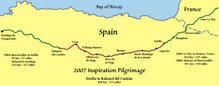
I am doing a talk on the Camino to a local reading group on Monday and so put together an annotated bibliography. It is, by no means exhaustive — it represents some of what I have at hand — but it might be useful for the person who googles the Camino. [photo: 765 km mark in Spain in the Pyrenees in the fog, 29 May 2006]
Guidebooks
Brierly, John. A Pilgrim’s Guide to the Camino Francés: From Saint Jean Pied de Port to Santiago de Compostela. Findhorn, Scotland: Camino Guides. 2003. A thorough guide, with maps, lodging recommendations for each stage of the Camino, complete with elevations to inspire or discourage, and meditations.
Clouteau, Lauriane and Marie-Virginie Cambriels. Miam Miam Dodo: Le Chemin de Saint Jacques de Compostelle, El Camino Francés. Les Sables d’Oronne, France: Les Editions du Vieux Crayon. Published annually. If you speak French, this guide is the Cadillac of guide-books for lodging, food, internet cafés, and anything else practical. It also has pithy quotations on otherwise blank pages.
Facaros Dana and Michael Pauls. Northern Spain Cadogan Guide. Guilford, CT: The Pequot Press. 1996, 1999, 2001, 2003. Very good descriptions of the places through which the Camino meanders as well as thorough historical overview. Written with a gentle sense of humor. One needs to stitch together a through-plan of the Camino but worth the effort.
Gitlitz, David and Linda Kay Davidson. The Pilgrimage Road to Santiago: The Complete Cultural Handbook. New York, NY: Saint Martin’s Griffin. 2000. The title says it all. Way too big to carry while walking, it is wonderful to consult post walking.
Jacobs, Michael. The Road to Santiago, third edition. London: Pallas Athene. 1991, 2002. A good, compact book with lots of photographs and information, worth consulting before leaving.
Lozano, Millán. A Practical Guide for Pilgrims: The Road to Santiago, 8th ed.. Madrid: Editorial Everest, S. A. N.D. Works very well with Brierly and the other guide books. Even comes with a map pouch and separate maps!
Mullins, Edwin. The Pilgrimage to Santiago. Northampton, MA: Interlink Books. 1974, 2001. While the author drove as much as walked the route, the narrative is a treasure-trove of details of places along the way in France and in Spain.
Roddis, Miles et. al. The Lonely Planet: Walking in Spain, third edition. Oakland, CA: The Lonely Planet. 2003. The guide contains a 35-page section devoted entirely to the Camino. The stages are slightly different from those of many other guidebooks but it is worth using in tandem.
Raju. Alison. The Way of Saint James: Le Puy to the Pyrenees. Cumbria, UK. 2003. Obtained in the US through a North Carolina map website, this guide works well with other guides (especially when operating out of either French or Spanish guides as we were). Once one deciphers the British expressions for road surfaces, the guide is useful.
Symington, Andy. Footprints: Northern Spain Handbook. London: Footprint Books (distributed in the US by Publishers Group West). ND. Same operational principle as the above two guidebooks: once one pieces together the Camino from the various sections of the book, one has a good guide. The writing in this book is quite funny at times but the information is accurate.
Narratives/Spiritual Reflections
Buck, Jean Ann. Walking for Wildlife: El Camino to Santiago de Compostela. Leicestershire, UK: Upfront Publishing. 2004. A grandmother of four walks to raise money to protect Manx wildlife. A light read but contains interesting nuggets and is authentic (based on her journal).
Christmas, Jane. What the Psychic Told the Pilgrim: A Midlife Misadventure on Spain’s Camino de Santiago de Compostela. Vancouver, Canada: Greystone Books. 2007. An entertaining yet accurate description of a 50 year-old woman’s walk across Spain with a group of 14 women that the author manages to lose halfway through her pilgrimage.
Egan, Kerry. Fumbling: A Journey of Love, Adventure, and Renewal on the Camino de Santiago. NY, NY: Broadway Books. 2006. Egan walked the Camino with her fiancé after her father’s death. Her account is honest about her struggles both on the Camino and spiritually, as well as funny at times.
Rudolph, Conrad. Pilgrimage to the End of the World: The Road to Santiago de Compostela. Chicago: University of Chicago Press, 2004. Divided into four sections, the book contains a brief but accurate history of pilgrimage to Santiago, the author’s pilgrimage, views of the journey, and a how-to section.
Rupp, Joyce. Walk in a Relaxed Manner: Life Lessons from the Camino. Maryknoll, NY: Orbis. 2005. Rupp, a well-known writer of spiritual meditations, reflects on her walk on the Camino. While the book could have used better editing, and at times tends almost toward a New Age-y tone, Rupp’s main observation of learning to slow down is well taken.
Schell, Maria and Donald. My Father, My Daughter: Pilgrims on the Road to Santiago. New York, NY: Church Publishing. 2001. A short, entertaining read written by a father and daughter team who walk the camino that describes the outward and inward journey and development of their relationship.
General Books on Pilgrimage With References to Santiago
Cousineau, Phil. The Art of Pilgrimage: The Seeker’s Guide to Making Travel Sacred. York Beach, ME: Conari Press. 1998. A general meditation on what pilgrimage is in general, with references to pilgrimages throughout the ages, and the spiritual how-to of embarking on a pilgrimage.
Lash, Jennifer. On Pilgrimage: A Time to Seek. New York, NY: Bloomsbury Press. 1991. This book describes Lash’s setting off on pilgrimage after cancer surgery. Travelling by rail and foot, she covers the major pilgrimage sites in France and Spain.
McPherson, Anne. Walking to the Saints: A Little Pilgrimage in France. The book describes her visits to major Romanesque sites along the way of several pilgrimage routes in France.
Mahoney, Rosemary. The Singular Pilgrim: Travels on Sacred Ground. Boston: Houghton Mifflin Company. 2003. Her journey to Santiago is one of six pilgrimages she describes with piercing honesty. (Her description of the Camino is rather bizarre.)
Robinson, Martin. Sacred Places, Pilgrim Paths: An Anthology of Pilgrimage. London: Marshall Pickering. 1997. This anthology contains quotations from across the centuries and is fun to open up and read a few selections on a whim.
Internet Resources
http://www.santiago-compostela.net/ This website has photographs of every stage of the Way, both in France and Spain. It has lots of good resources as well as chat boards.
http://www.caminodesantiago.me.uk/ This site is still under construction but has some interesting material.
http://www.globecorner.com A fantastic bookstore in Cambridge MA has books on the Camino.
http://www.omnimap.com A good source for the French guides to the GR65 and also various walking guides for the Camino.
If you google Santiago de Compostela you’ll come up with many more sites.