Showing posts with label Camino. Show all posts

05 January 2008

Annotated bibliography


I am doing a talk on the Camino to a local reading group on Monday and so put together an annotated bibliography. It is, by no means exhaustive — it represents some of what I have at hand — but it might be useful for the person who googles the Camino. [photo: 765 km mark in Spain in the Pyrenees in the fog, 29 May 2006]

Guidebooks
Brierly, John. A Pilgrim’s Guide to the Camino Francés: From Saint Jean Pied de Port to Santiago de Compostela. Findhorn, Scotland: Camino Guides. 2003. A thorough guide, with maps, lodging recommendations for each stage of the Camino, complete with elevations to inspire or discourage, and meditations.

Clouteau, Lauriane and Marie-Virginie Cambriels. Miam Miam Dodo: Le Chemin de Saint Jacques de Compostelle, El Camino Francés. Les Sables d’Oronne, France: Les Editions du Vieux Crayon. Published annually. If you speak French, this guide is the Cadillac of guide-books for lodging, food, internet cafés, and anything else practical. It also has pithy quotations on otherwise blank pages.

Facaros Dana and Michael Pauls. Northern Spain Cadogan Guide. Guilford, CT: The Pequot Press. 1996, 1999, 2001, 2003. Very good descriptions of the places through which the Camino meanders as well as thorough historical overview. Written with a gentle sense of humor. One needs to stitch together a through-plan of the Camino but worth the effort.

Gitlitz, David and Linda Kay Davidson. The Pilgrimage Road to Santiago: The Complete Cultural Handbook. New York, NY: Saint Martin’s Griffin. 2000. The title says it all. Way too big to carry while walking, it is wonderful to consult post walking.

Jacobs, Michael. The Road to Santiago, third edition. London: Pallas Athene. 1991, 2002. A good, compact book with lots of photographs and information, worth consulting before leaving.

Lozano, Millán. A Practical Guide for Pilgrims: The Road to Santiago, 8th ed.. Madrid: Editorial Everest, S. A. N.D. Works very well with Brierly and the other guide books. Even comes with a map pouch and separate maps!

Mullins, Edwin. The Pilgrimage to Santiago. Northampton, MA: Interlink Books. 1974, 2001. While the author drove as much as walked the route, the narrative is a treasure-trove of details of places along the way in France and in Spain.

Roddis, Miles et. al. The Lonely Planet: Walking in Spain, third edition. Oakland, CA: The Lonely Planet. 2003. The guide contains a 35-page section devoted entirely to the Camino. The stages are slightly different from those of many other guidebooks but it is worth using in tandem.

Raju. Alison. The Way of Saint James: Le Puy to the Pyrenees. Cumbria, UK. 2003. Obtained in the US through a North Carolina map website, this guide works well with other guides (especially when operating out of either French or Spanish guides as we were). Once one deciphers the British expressions for road surfaces, the guide is useful.

Symington, Andy. Footprints: Northern Spain Handbook. London: Footprint Books (distributed in the US by Publishers Group West). ND. Same operational principle as the above two guidebooks: once one pieces together the Camino from the various sections of the book, one has a good guide. The writing in this book is quite funny at times but the information is accurate.

Narratives/Spiritual Reflections
Buck, Jean Ann. Walking for Wildlife: El Camino to Santiago de Compostela. Leicestershire, UK: Upfront Publishing. 2004. A grandmother of four walks to raise money to protect Manx wildlife. A light read but contains interesting nuggets and is authentic (based on her journal).

Christmas, Jane. What the Psychic Told the Pilgrim: A Midlife Misadventure on Spain’s Camino de Santiago de Compostela. Vancouver, Canada: Greystone Books. 2007. An entertaining yet accurate description of a 50 year-old woman’s walk across Spain with a group of 14 women that the author manages to lose halfway through her pilgrimage.

Egan, Kerry. Fumbling: A Journey of Love, Adventure, and Renewal on the Camino de Santiago. NY, NY: Broadway Books. 2006. Egan walked the Camino with her fiancé after her father’s death. Her account is honest about her struggles both on the Camino and spiritually, as well as funny at times.

Rudolph, Conrad. Pilgrimage to the End of the World: The Road to Santiago de Compostela. Chicago: University of Chicago Press, 2004. Divided into four sections, the book contains a brief but accurate history of pilgrimage to Santiago, the author’s pilgrimage, views of the journey, and a how-to section.

Rupp, Joyce. Walk in a Relaxed Manner: Life Lessons from the Camino. Maryknoll, NY: Orbis. 2005. Rupp, a well-known writer of spiritual meditations, reflects on her walk on the Camino. While the book could have used better editing, and at times tends almost toward a New Age-y tone, Rupp’s main observation of learning to slow down is well taken.

Schell, Maria and Donald. My Father, My Daughter: Pilgrims on the Road to Santiago. New York, NY: Church Publishing. 2001. A short, entertaining read written by a father and daughter team who walk the camino that describes the outward and inward journey and development of their relationship.

General Books on Pilgrimage With References to Santiago
Cousineau, Phil. The Art of Pilgrimage: The Seeker’s Guide to Making Travel Sacred. York Beach, ME: Conari Press. 1998. A general meditation on what pilgrimage is in general, with references to pilgrimages throughout the ages, and the spiritual how-to of embarking on a pilgrimage.

Lash, Jennifer. On Pilgrimage: A Time to Seek. New York, NY: Bloomsbury Press. 1991. This book describes Lash’s setting off on pilgrimage after cancer surgery. Travelling by rail and foot, she covers the major pilgrimage sites in France and Spain.

McPherson, Anne. Walking to the Saints: A Little Pilgrimage in France. The book describes her visits to major Romanesque sites along the way of several pilgrimage routes in France.

Mahoney, Rosemary. The Singular Pilgrim: Travels on Sacred Ground. Boston: Houghton Mifflin Company. 2003. Her journey to Santiago is one of six pilgrimages she describes with piercing honesty. (Her description of the Camino is rather bizarre.)

Robinson, Martin. Sacred Places, Pilgrim Paths: An Anthology of Pilgrimage. London: Marshall Pickering. 1997. This anthology contains quotations from across the centuries and is fun to open up and read a few selections on a whim.

Internet Resources
http://www.santiago-compostela.net/ This website has photographs of every stage of the Way, both in France and Spain. It has lots of good resources as well as chat boards.

http://www.caminodesantiago.me.uk/ This site is still under construction but has some interesting material.

http://www.globecorner.com A fantastic bookstore in Cambridge MA has books on the Camino.

http://www.omnimap.com A good source for the French guides to the GR65 and also various walking guides for the Camino.

If you google Santiago de Compostela you’ll come up with many more sites.

13 November 2007

A Camino Day

It's a Camino day

... at least in thought. Maybe it's because I collected up all the various guidebooks and travel narratives about it last night. I have to do a presentation on the the camino in January to the local ladies' reading group so it has been on my mind. It also has been on my mind because this coming spring for the first time in four years, I won't have the rhythm of the camino to look forward to. It's partly because we have finished it, there's little enthusiasm to redo parts of it right now and mostly because the dollar against the euro is so low that we couldn't afford it (1E = $.145).

I ran across this paragraph the other night in an online essay, A Pilgrim, but a Tourist Too by Denise Fainburg:

None of the guidebooks tells you that walking the Camino is something of an extreme sport. It lacks the cachet of, say, sky-diving, but everyone has a tale to tell of pinched nerves, fractures, tendonitis, or the more prosaic blisters. Each evening in the refugios you will see walkers tenderly anointing and disinfecting their feet.

Gee, I have been engaging in an extreme sport all these springs and I didn't even know it!

My feet sure say so. I have lasting effects from walking all those kms and miles. My left foot shows no inclination of completely healing from the plantars fibramatosis; the lump in the arch remains. And the tendon around my ankle that goes to the arch still cramps up. Even with orthotics and switching my exercise activity to rowing which doesn't use the foot in the same way, it's still funky.

But, oh, how I want to walk. How I miss it. The big question is: with what walk in a place that uses the dollar can I satiate that need? I still need to have a long walk to look forward to.

Perhaps I want the walk to know that I am still mentally able to meet such a challenge, to keep on going when it would be so easy to get on the bus and knock off 50 kms in an hour rather than in a day and a half. (In so many of the books I have read of other people's experience, the authors talk about bailing out and taking the bus or train... usually for health reasons, like being too sick to walk from ingesting bad water.) I am glad that I have walked every single inch of that camino, including bonus miles. So I want another like challege as a way of proving to myself that, yes, I am capable of rising to a challenge and finishing it.

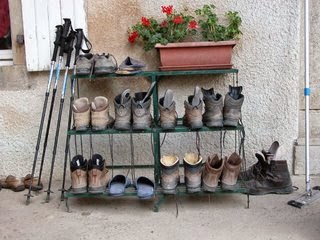
[feet, day 2, May 2006 29.5 kms outside of Moissac, France, in Saint Antoine, a week and a half after I broke the pinky toe and fourth metatarsal.]

20 May 2007

This is the Day


There's a fog settled over the mountain ridge across the way. It looks like a camino morning, like the morning we set out from Ostabat, the last leg before Saint Jean-Pied-de-Port and the Pyrenee crossing into Spain. I can well anticipate quiet mornings like today. By now we'll be on the road, walking. I am telling my feet to enjoy the next day's rest because it's all over on Tuesday.

This is the day we leave after so long. Again.

The cats know. The only way to leave them is to walk out the door and not look back. It is always very difficult for me to leave them behind even though I know they are in superb hands.

This segment of the camino takes the pilgrim through the barren alteplano where there are no landmarks, only a straight path, now lined apparently with saplings that someday will provide shade for the pilgrim.

It is said that people have visions on the alteplano because they become disoriented. That's better than the more perilous saying that demons will assault the pilgrim's soul.

I figure walking this chunk of the camino will be like crossing the Atlantic Ocean (which I did on the QE2 in 1977). For three days there was only sky and sea. We didn't even see a single bird. It stormed, the sea was rough, and there wasn't much of a vista. But it was vast and awesome. That's how I anticipate seeing the alteplano (or like being in Texas where everything is huge and you get 'big skies').

Regardless, we are off.

Vaya con Dios.

18 May 2007

Two days....


In two days we will be en route to Spain to walk the last leg of the Camino.

It's incredible. Something awaited for so long, something that even though, for the fourth time and therefore is more familiar, demands such preparation, and now it is almost here.

By Tuesday, we will once again be looking for yellow shells on a blue background or something to that effect to guide us through towns.

Unlike last year, we will not walk our first day abroad; we'll end up arriving in Pamplona and then have the afternoon to explore the city. The next day we will get on a bus, our last conveyance until 16 days later, and walk 20 kms.

My mind knows what the rhythm of the day is: get up, get into the same clothes that have dried overnight, go have breakfast (in Spain, un cafe doble), come back to the room, fill up the water bottle first (camelback), stuff it into the pack and THEN pack the pack making sure I don't step on the bite valve (it's so easy to do and such a pain to clean up the water puddle that has formed, plus have to empty the pack out again). Go through everyone's prayers (I carry with me handwritten prayers on little slips of paper), so they will float with me for the day, read the daily office readings, and then... start walking.

On the way out of town, if necessary, we stop to get food (bread, cheese, fruit). And, sometimes, yes, we have to hit an ATM.

Usually we stop for a snack (banana and perhaps some form of pastry, in France, it was a croissant, of course) around 10.30 or 11.00, if we've been walking since 8.00. Then we walk until 1.00 or 2.00, sometimes waiting until we can find a place in the shade to sit. We settle down, take off our boots and socks, let our feet get some sun and air. Lunch can be half an hour, and then it's back to walking. The afternoon drags on more than the morning and we take more breaks, albeit short, about 10 minutes. Of course, the schedule can be completely thrown out of whack if there's a church to visit. The last hour always drags on and it seems as though we are never going to get to our destination.

We try to arrive at the next night's lodging by 5.00 or 6.00, though in Spain, dinner is later so it's not quite as much of a crunch as in France where dinner starts at 6.00 or 7.00. Once at the place, it's take off the boots, get out of the day's walking clothes, wash them and whatever other accrued laundry there is (though there isn't much) so that they can have a night to dry on the parachute cord we string in the room. We're not into having our smalls air on the back of our packs as we walk :) (There are some folks whose packs are such a mess you wonder how they stay balanced on the person's back!)

Then there's dinner and then back to our room. I write up the day in my small journal. And then, it's to bed... sometimes with aching limbs that impede a good sleep, sometimes just out like a light.

Then, it's up to start all over again. We'll do this for 16 days straight. I am ready.

Photo: shell in Ciraqui, Spain, 2004

14 May 2007

The Pilgrims' Progress


This sign is about 1 km from the cathedral in Le Puy, France, from the start of the Via Podensis that leads pilgrims through Aubrac, Conques, Quercy, Moissac, le pays basque, over the Pyrenees to Spain and then to the Via Frances. By the time we finish up on 9 June, we will have walked all those kms.

This go-round we will walk the following distances:
Day 1, 22 May, 21.4 kms
Day 2, 23 May, 28 kms
Day 3, 24 May, 29.5 kms
Day 4, 25 May, 21.3 kms
Day 5, 26 May, 23.5 kms
Day 6, 27 May, 30.6 kms
Day 7, 28 May, 21.2 kms
Day 8, 29 May, 20.5 kms
Day 9, 30 May, 31.4 kms
Day 10, 31 May, 28.2 kms
Day 11, 1 June, 33.1 kms
Day 12, 2 June, 32.1 kms
Day 13, 3 June, 28.2 kms
Day 14, 4 June, 29.9 kms
Day 15, 5 June, 32.1 kms
Day 16, 6 June, 20.6 kms

Oh, my feet!

There are bibles and there are bibles


This little book, Miam-Miam Dodo, French for 'Din-din, beddy-bye,' is indispensable. Revised every year, it contains a wealth of information about lodging, restaurants, which places have laundry facilities, covered sheds for horses or donkeys (one does see such critters on the way), internet (usually not an interest but this year, more important), and which towns have stores for food, pharmacies, banks and so forth. The publishers issue one for the Chemin in France and the Camino in Spain. For the past three years (that is, 2005, 2006, 2007), we have used them. Their maps are fairly vague so we add in other maps from other sources.

So while there is THE Bible, there are other bibles which sometimes (for me at least) give clearer directions.

While walking there are always waymarks that show the way to go. The shell, in particular, is common in Spain. It's like walking on a long treasure hunt, looking for the next yellow arrow or shell on a lamp post, side of a house, in the pavement, wherever, that will indicate a turn.

If one goes along for a while without seeing a sign (unless there's nothing else in creation nearby), one begins to wonder if one missed a turn. We've only done that twice in all the kilometres, both in France and Spain, and we usually were able quickly to figure out where we missed the turn.

Following the camino is not like life where turns are not so clearly marked and where it is far easier to wander inadvertantly (never mind the conscious times) from the path. Often, too, there are not companion pilgrims nearby to yell or whistle to let one know that one missed a turn. (Though one day when we intentionally left the Camino to go to our inn, we had someone insist that we had gotten off the path and needed to return.)

By this time next week, we will be asleep, ready to start walking our first day. Wow!

13 May 2007

One week and counting


Somehow, all this stuff needs to get into my pack. Since this is the fourth go-round, the packing happens pretty automatically, and in little time, I have managed to get practically everything into the pack. I haven't weighed it yet, though... partly because that means I have to weigh myself first.


In short order, everything is organised for next Sunday's departure, including my 'evening clothes,' the fleece, shirt and pants I will wear when I am not in my walking clothes. From previous experience, I know that I have to keep the top of my pack detached if it is to be lightweight enough to put in the overhead bins (since we're not checking anything). In the plastic bag, which sadly I will ditch in Spain (contributing to more plastic bag pollution), I have my pouch which attaches to my pack waist band, my sandals, the battery recharger for the camera and some other heavy items.

My cat knows that I am up to something; hence, her sleeping not quite on top of but close enough to my clothes. I will take her fur with me.

The 0.7% button will go on the outside of my pack once we get settled and stop flying, that is, when we finally land in Pamplona next Monday.


Now it's time to start painting the soles and sides of my feet and my pinky toes with the awful-smelling tincture of benzoin. It's the only way to minimise the assault of blisters. It's not readily visible, but I have a lump smack in the middle of the arch of my left foot; the lump is part of the plantars fascia so it got a good swabbing tonight.

When one walks like this, fifteen miles a day with an extra 40 pounds (25 pounds for the pack, water and pouch, and 15 pounds overweight), one's world shrinks to worrying about one's feet and knees, which take the brunt of the walking.

Why this should be such a big deal for me, I don't know, since most of the world spends its days walking with more weight (I think of all the people I see in El Salvador carrying bundles of sticks on their heads or water jars) than I will. They don't have the luxury of smearing a preventative medicine on their feet, nor do they have the nice boots, wool socks and plasters that I will have to protect my feet (which are pretty roughed up because I like to go barefoot).

Walking as I will, as a pilgrim, will be luxurious compared to how my sisters and brothers walk. But, as I have written downstream, I walk because they walk and perhaps in my walking, I can remember them.

I have no idea how the fund raising is going but I hope folks are hitting that 'Donate to ERD' button :)

07 May 2007

Will it be like this? Hope not!


This excerpt comes from Kerry Egan's Fumbling: A Journey of Love, Adventure, and Renewal on the Camino de Santiago (NY, NY: Broadway Books, 2006), 89-91. In order to keep the entry PG, I am altering the expletives, though they sort of add to the character of the passage and actually render it comical. You'll figure out what they are.

+++

The days always dawned cool and clear, but by ten the sun would really begin to heat up. By noon we were walking through wheat as far as the eye could see. From the top of any small rise you could spin in a circle and see only blocks of yellow or gold or pale green with faint zigzagging red lines running through them: fields of wheat planted at different times and the red-and-orange poppy flowers that floated above the grain, bobbing in the breeze like paper teacups. In the distance, on hills rising above the fields and with roads climbing out of the wheat to meet them, small towns huddled in on themselves. Always at least one church steeple rose from the town, sometimes high and graceful but usually short and worn down, the edges of the stone buffered to smooth curving shapes. The sky was the color of old blue glass bottles, with only whispy clouds low on the horizon. A giant blue platform for the sun.

The sun was everywhere. Everything seemed to have become sun — the wheat, the road, Alex, myself. I hated the sun. I hated the heat and the I hated the relentless way it just kept beating down on me, regardless of how I felt or what I did. I hated the heat rash it gave me and the headache it caused, I hated how hot it was, but mostly I hated how inescapable it was. There was no shade anywhere, no trees, no buildings, and no clouds to blot it out, even for a few seconds. It burned right through the top of my head, like a skewer that ran down my spine and stuck me to the ground.

I did not want this sun anymore. I was in fear of the sun. I thought about it constantly. I began praying, both as I walked and at night before I fell asleep that there would be clouds the next day to block it, or some trees to throw shadows across the road. Day after day I begged as I walked. "Please please please God let there be some clouds. Or trees. Just five minutes of shade and it would all be okay. Please, God. I'll do anything. Just some shade."

The sun kept shining that afternoon, as it had for the past week. I explained to God why I needed shade, or ever better, a cool rain shower. No response. Anger welled up in my throat. Was it so much to ask for a single cloud? All around the waist-high wheat continued to rustle gently. I hated that wheat which never offered shade. I stormed three feet into the field.

Wheat hurts. It scrapes and burns. This just further enraged me.

"Effing wheat. GD effing wheat."

A steady stream of expletives erupted from me. I don't really curse and it was a surprisingly liberating feeling. I kicked the wheat. It felt so good that I kicked again and again, circling around myself and kicking in every direction. With all my body weight behind me, I shifted onto one leg to let the other fly as hard and fast as I could. The backpack threw me off balance and I almost fell. "GD backpack!" and flung the thing off me. "Stupid sun! Couldn't there be any clouds! Nooooo! Of course not! All I effing ask for is some effing clouds, but never. I pray and pray for a cloud or a tree, but you just ignore me. You probably laugh at me. GD effing prayers are never answered. I am a good person, you know. Do you know that? Do you care? Do you effing listen? All I wanted was a effing tree!" I stood in a wheat field screaming at the clear blue sky and blazing sun. Silence. So I started kicking again and I didn't care that it hurt. It felt good.

"Why are you kicking the wheat?" Alex asked.

"Because it is not a effing tree," I screamed back.

"Really?"

"Yes. And you should, too. Don't you hate it?" I asked, turning on him.

He rubbed the back of his neck and looked at me. "Why should I hate it? It's just wheat. It just stands there."

This enraged me even more. I started howling. I wasn't even using words any more, but just sounds. I was shaking and screaming as loud as I could. I'd lost control of myself and I knew it. I couldn't stop. Was Alex such an idiot? Couldn't he see that the wheat just standing there was exactly the problem? That no matter what I did, I could do nothing to change the wheat into a tree? I was completely powerless. This was a betrayal of all I had ever been taught about hard work and responsibility and justice and fairness. I kept kicking.

I hear a click. Alex has taken a picture of me.

"What are you doing?"

"You'll want to remember this someday," he said, dropping the camera into his backpack.

I picked up my bag, stumbled out to the road, and started walking again. "I feel better," I said. Alex didn't answer.

We walked on in silence.

02 May 2007

Three weeks from today...

... we'll be walking from Estella to Los Arcos.

Mientras, three years ago, we were closing in on Santiago de Compostela, having started about the 20th of April from Roncesvalles.

This morning I went to a neat site that generates maps and elevations for the portion of the camino (or chemin) that one walks.

Here are the three maps for the portion of the camino we will be walking. [Click on them for enlargements.]

Map 1


map 2


map 3


The elevation gains aren't too wild — it's not like the spike one sees when one goes from Saint-Jean-Pied-de-Port to Roncevaux/Roncesvalles, nor is it the up and down one sees as one approaches Santiago.

The breakdown of stages between El Burgo Ranero and Astorga don't correspond exactly to where we'll be spending the night but they are close enough and one way or another, we will walk the 85 kms between the two places.

This is getting more real! I am beginning to collect all my walking clothes and accessories and dump them on the spare bed. Now, if only I had more energy....

30 April 2007

Se acerca (it's getting close)


Three weeks from today we will have breezed through Pamplona (where this medieval pilgrims' bridge is) on our way to Estella where we will start walking. I am not sure whether we will spend the night in Pamplona; we will certainly try to visit there because we didn't get into the cathedral three years ago when we walked through there.

I have started to put things out that will go into my pack. I don't have a lot of time and want to avoid the last-minute running-around preparations that have characterised other departures for the camino/chemin.

Unlike our two trips to France, this time we will have to take sleeping bags. In France, the gîtes (hostels) provide blankets, pillows and pillow cases. In Spain, you get a mattress at the refugios. I now have a lightweight, super-compressable sleeping bag (it would not do on a cold night in the New Hampshire Whites) that I can put at the bottom of my pack.

The trip is getting more real now. I even checked the weather and see that it is raining in both León and Burgos.

16 April 2007

Slogging along


As is so often the case, when reality hits one's dreams, it can be disappointing.

For months we researched backpacks, footwear (hiking boots), walking sticks, outerwear, water containers and exactly how much things would weigh so that we wouldn't be carrying too much. We looked through every guide on the Camino we could get our hands on, ordering them through the internet. We plotted our route, figuring out the stages we would walk. I revisited my medieval French texts, specifically La Chanson de Roland, since so much of the initial portion of the Camino consists of places named in these texts.

Finally, we flew from the US to Madrid to Pamplona and took a taxi ride up to Burguete where we would spend the night in the little hotel where Ernest Hemingway used to stay. We walked the 2+ kms from Burguete up to Roncesvalles so we could go to the pilgrims' mass, be blessed and sent on our way. The night we walked up there was clear and not too chilly. We could sort of make out the Pyrenees behind the little town.

The next day, our very first day of walking, it POURED rain. We got lost within the first 10 metres because we couldn't find how the Camino hooked into the little town so we walked 3 or 4 kms on the main road. And when we finally found the Camino, it was so muddy that walking was treacherous. The Camino was so badly eroded that one walked on granite slabs that had a downward tilt. The path was extremely narrow.

Needless to say, we did not see the mountains at all that day.

To make the day perfect, my water container split so all the water ran down my back, and caused my rain pants to dye my khaki pants under them various shades of blue. I was so wet from the rain that I didn't notice; we didn't figure it out until the evening when we completely emptied our packs, strung up parachute cord for clothes lines and even hung our airplane tickets and passports on them to dry out.

+

As with any long-haul adventure, there is the initial flush of excitement, the expectation of the journey, and the dreams of how it will go. With any long-haul adventure, disappointments come along, one gets bogged down but usually one can walk one's way through it.

I hope our youth group doesn't get too bogged down in their attempts to raise $1500 for the Inspiration Fund. I hope they don't get disappointed. Likewise, in the larger picture, I hope people don't get discouraged. It is possible to make one's goal... it just takes some slogging through the mud.

14 April 2007

Gotta keep on walkin'


Thought for the day

"Above all, do not lose your desire to walk:
every day I walk myself into a state of well-being
and walk away from every illness;
I have walked myself into my best thoughts,
and I know of no thought so burdensome that one cannot walk away from it....
the more one sits still, the closer one comes to feeling ill....
thus if one just keeps on walking, everything will be all right."

— Soren Kierkegaard

[Alto de Pardon outside of Pamplona, April 2004 — note the wind turbine: the province of Navarra gets something like 30-40% of its electricity from wind farms]

10 April 2007

The long haul


The Cadogan Guide, Northern Spain (Dana Facaros and Michael Pauls), describes the Alteplano thusly:

If the medieval pilgrim survived the storms, cut-throats and wolves at Roncesvalles, the Navarrese who exposed themselves when excited, and the dupers and fleshpots of Burgos, then they faced the dustiest, flattest, hottest and most monotonous landscape in Europe. The idea is that with nothing to look at one becomes introspective and meditative, altogether in a proper state to receive enlightenment. On the other hand, nearly all the route between Burgos and León is off the highways, on paths and lonely backroads where 20th-century intrusions are rare: their straggling hamlets of humble adobe houses, church towers crowned with storks and huge dovecotes (pigeon was the only meat the country folk could afford) evoke the Middle Ages as powerfully as any cathedral (272-73).

That is what we are opting to walk this May. Last year, in late May, we stayed at the home of someone whose father was on the Alteplano. Apparently, it was literally freezing with a stiff wind blowing into his face and he was most cold. So, we don't really know what sort of weather we're going to get.

Everyone says this portion is terrible and we certainly had pity on the pilgrims we saw three years ago as we whizzed by in the train. This go-round, we'll be the poor people slogging away, either roasting or freezing or maybe if we're lucky comfortably.

01 April 2007

Credentials


It's springtime and life on the Camino is cranking up. I got an email this morning from a woman I have never met but whom I advised last year when she and her sister were preparing to walk the Camino. The writer loved it; the sister did not and so they ended only after a week or so. Now, the writer is returning to finish the Camino without her sister. She loved being in Spain during Holy Week and Easter and so she will spend those days walking. She wrote to those whom she knows who have walked the Camino asking for our prayers. She has them, of course.

Those who undertake the camino as a spiritual exercise or pilgrimage, however they define it, usually get a Credencial at the starting point in Roncesvalles, tucked away in the Pyrenees. Many people actually start walking on the other side of the Pyrenees, in France at Saint-Jean-Pied-de-Port, so they can say they have crossed the mountains. We finished up last year in Spain in Roncesvalles, ending where we had begun walking in 2004. Unfortunately for us, the day we crossed the Pyrenees, it was pea soup so we didn't get to see the vista. Instead, all we saw were sheep in the fog, hearing them before we came upon them.


In any event, the Credencial is the pilgrim's passport to lodging at refugios and aubergues (hostels) along the way. There's a hierarchy of need on the Camino: those who walk get first crack at lodging, then those who bicycle, then those who walk without transporting their belongings on their back and, if there's any room left, those who drive the Camino. In France, one can make reservations; in Spain, usually one can't so that leads to a race to get to the hostels early enough to get a bed and, preferably, not in the middle of a large room. The three of us tend to opt for one-star hotels because it makes doing nightly laundry oh so much more easy.

The pilgrim gets the Credencial stamped with the locales of where one stays. It seems ridiculous to see a bunch of adults asking inn-keepers to stamp their Credencial but there's logic to the madness because one has to have proof of walking the last 100 kms (66 miles) in order to get the coveted Compostela, the certificate that states that the pilgrim has completed the pilgrimage... for spiritual reasons.

We will take the Credencial we started and finished in 2004 and work on the middle chunk. We're doing this all out of order but it doesn't matter; we will have covered every inch of the Camino (and then some).

31 March 2007

Beginning to walk


The whole idea of pilgrimage for me goes back a long, long time from the summer I spent with my cousins, living in the Netherlands. I bugged them all summer to go into Amsterdam so I could see Anne Frank's house, at the time in 1971, just made into a human rights museum. At age 14, I wasn't too clear about what 'human rights' meant, but I was clear that Anne had been a light for the world. I didn't get to spend nearly enough time in her house, going through the secret bookcase (something that pilgrims nowadays apparently can no longer do), and walking around in the rooms her family, friends and she inhabited.

Walking the Camino de Santiago is another form of pilgrimage, one that dates back to the 800s when a farmer looked up in the night sky to see a bright star that shone on the spot where the bones of Saint James were resting. Compostela, as in campus, field, stellae, of stars, became the destination for medieval pilgrims desirous of expiating their sins. (It was referred to as the Milky Way at one point in its history.) The Camino's popularity took off during in the 11th century but fell out of popularity until the 1990s when the United Nations made it a world monument. Now, thousands of pilgrims from around the world, make the journey from one end of northern Spain to the other, starting in the Pyrenee mountains where the medieval epic hero, Roland, Charlemagne's son, was killed in an ambush, and ending in Santiago, some 700+ miles later.

Three years ago, we three pilgrims, each for different reasons set off on the Camino. We only had time to do the first 100 kms and the last 250 or so, thereby skipping the middle section of the Alteplano, the long, flat, open and hot segment that we watched miserable pilgrims (or so it seemed) from our comfortable seats in a speedy train. Subsequently, we walked the Chemin de Saint Jacques, the Via Podensis, starting in Le Puy, France and ending in the Pyrenees in the French town of Saint-Jean-Pied-de-Port.

So, now, this spring, we will walk the last 272 miles. And this time, it will be dedicated to Episcopal Relief and Development's Inspiration Fund. Every other walk we have literally carried people's prayers, handwritten on little pieces of paper. We will do that this time, too, but we will also leave in our path information about the Millennium Development Goals.

I am grateful to a colleague who also is walking the Camino (albeit in a different spot), who is raising money for an organisation that works with the MDGs. Thanks to her idea which got this one going.

That is a little bit of the big picture.

[As for the photo that accompanies this posting, it is taken from the top of the mountain ridge that separates Pamplona from the open terrain, with nearby Eunate, a Romanesque funerary chapel for fallen pilgrims of the middle ages. One hikes up the the Mont Pardon to find oneself alongside wind turbines — the province of Navarra prides itself on a large percentage of its energy being generated by wind — and a modern statue of a pilgrim and mule. It's quite dramatic.]

30 March 2007

The Inspiration Pilgrimage


Over the course of the next six or seven weeks, I will be posting information both about the Inspiration Fund that Episcopal Relief and Development is creating to raise money for the Millennium Development Goals, particularly Goal #6, the eradication of HIV/AIDS, malaria, tuberculosis, and other diseases and the Camino de Santiago de Compostela in northern Spain.

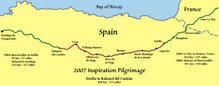
The idea of combining this medieval pilgrimage walk with raising money for the eradication of age-old diseases seems most fitting as we close out our 1500+ kilometre walk that began in April 2004. We walk about six-eight hours a day, averaging about 15 miles. Our walk this spring will take 16 days to go from Estella-Rabanal del Camino, Spain (the portion in red on the adjacent map).

Bienvenidos/as a este camino. Welcome to this journey.