Showing posts with label MDGs. Show all posts

07 May 2007

Hand-outs


In most of the churches in France that the pilgrim visits, one finds a notebook in which the pilgrim can write prayers and read what people beforehand have written. I became the one who would write a small note, a prayer, or a thought, and then sign it with our names and home. Then I would read through the notes the people ahead of me had written. It became as much of a ritual as writing a candle (and a lot less expensive!).

So, for this year, I am printing out business cards that have on one side:

Peregrinas por los Objetivos de desarrollo del Milenio [Pilgrims for the MDGs]

[update: we're adding: Peregrinas Episcopales de los EEUU…]

and on the other side:

Objetivos de desarrollo del Milenio
1. Erradicar la pobreza extrema y el hambre
2. Lograr la enseñanza primaria
3. Promover la igualdad entre los géneros y la autonomía de la mujer
4. Reducir la mortalidad infantile
5. Mejorar la salud maternal
6. Combatir el VIH/SIDA, el paludismo y otras enfermedades
7. Garantizar la sostenibilidad del medio ambiente
8. Fometar una asociación mundial para el desarrollo

Fewer of the churches in Spain, as I recall, have these notebooks but I intend to leave these cards behind so that whoever follows might know why a few people are walking the Camino.

The accompanying photo here is of a little chapel that overlooks the wonderful village of Conques, France. It was a super hot and humid day when we climbed up out of the valley to this chapel and it was so nice and cool that we stopped and rested a little even though we'd only been walking 30 or 45 minutes. Someone had left a breviary on the altar and it was open to the day's readings which, though I don't remember what they were, seemed appropriate for the day.

06 May 2007

The agony of the feet


Sixteen days away, I wonder why am I going to spend sixteen days walking about 15 miles a day when it can be so painful?

Granted, I will not have two newly broken toes as I did last year (hence the white tape on the side of my left foot in the accompanying photograph), but the blisters and heat rash from the wool socks are a given. No matter what, it seems that one's feet suffer.

It's time to start coating them with tincture of benzoin, this brown, sticky and smelly stuff that turns your skin into leather and prevents blisters.

Unlike other years, I am going to stop walking from here on so as to save my feet. It's alternative forms of exercise.

Why do we do this?

In part, to use the words that CROP walkers say: 'We walk because they walk.'

So much of the world has to walk to get its water. It doesn't nicely flow from the tap whenever you want. And for multitudes, it doesn't even flow from a tap; it flows from a well down the road.

Think of how much time the population of the world, mostly women, spends going to get water.

And think of how much time school children spend walking to get to school. There are some communities in El Salvador that the Anglican Episcopal Church of El Salvador accompanies that get separated from the main road during the rainy season. It's a 5km walk to and from the main road and the children walk that so they can get to school.

So we walk because they walk.

26 April 2007

ERD testifies on Capitol Hill

From Episcopal News Service

ERD Congressional Testimony highlights role of faith-based institutions in fighting malaria in Africa
By Staff April 26, 2007 [ENS, WASHINGTON, DC]

In a hearing to mark Africa Malaria Day April 25, Episcopal Relief and Development (ERD) testified before a key U.S. congressional subcommittee on the role of faith-based organizations in fighting the malaria pandemic in Africa.

"The Church and other faith communities … are the first point of contact for help," Susan Lassen, a consultant who coordinates ERD's NetsForLife program in malaria control, told the House Foreign Affairs Subcommittee on Africa and Global Health.

"Faith communities have long had the ability to build and mobilize a delivery system that will reach the most vulnerable populations who live 'at the end of the road,'" said ERD President Robert W. Radtke.

Unparalleled infrastructure, capacity

"As the global community develops new and innovative methods to control and prevent malaria, the challenge of distribution becomes absolutely critical," Lassen told committee members. "NetsforLife capitalizes on the infrastructure of the Anglican Church to reach vulnerable populations."

The full testimony can be read [below].

NetsforLife is a one-year-old initiative of ERD, carried out in partnership with the Anglican Churches of Africa, to distribute one million insecticide-treated malaria-prevention bed nets in 16 sub-Saharan African countries by the end of 2008. Thus far, the program has distributed 213,000 nets in Angola, Zambia, Kenya, Ghana, Burundi, the Democratic Republic of the Congo, and Mozambique. It is funded by private individual donors, Churches, the Starr Foundation, the Coca-Cola Africa Foundation, the ExxonMobil Foundation, and Standard Chartered Bank. To learn more about NetsForLife, visit er-d.org/malaria

Also testifying at the hearing were Admiral Tim Ziemer, coordinator of the United States President's Malaria Initiative; Mark Grabowski, Malaria program manager for the Global Fund to Fight AIDS, Tuberculosis and Malaria; Enid Wamani, secretariat coordinator for the Uganda Malaria and Childhood Illness organization; Dr. Nils Daulaire, president of the Global Health Council; and Adel Chaouch of Marathon Oil and the Corporate Alliance on Malaria in Africa.

Bed nets are large sheets of insecticide-treated meshing designed to be draped over the beds or sleeping areas of people living in regions where malaria is prevalent. The nets shield users from malaria-carrying mosquitoes, which spread the disease during night hours.

Health-care professionals consider net use fundamental to efforts to prevent the spread of the disease, which causes more than 300 million acute illnesses and at least one-million deaths each year in developing countries.

"A mother and her two children can be protected from malaria for five years for a total cost of approximately $12," ERD told the subcommittee, explaining that this cost reflects not only the price of the net but also training in proper use, education in other methods to prevent malaria, and ongoing monitoring and evaluation.

An emerging consensus

In addition to ERD's focus on mobilizing the infrastructures of African Churches, the Episcopal Church is supporting malaria-control efforts through its advocacy to achieve the Millennium Development Goals (MDGs), said Alex Baumgarten, international policy analyst in the Church's Office of Government Relations in Washington, D.C. Goal 6 of the MDGs is "combat HIV/AIDS, malaria and other diseases."

"The advocacy of Episcopalians through the ONE Episcopalian campaign is playing an important role in building a new consensus in the U.S. Congress and Administration that fighting deadly poverty and disease throughout the world should stand at the forefront of our nation's foreign policy," said Baumgarten.

Since the beginning of 2007, Congress has approved more than $1.3 billion in increased funding for anti-poverty and disease initiatives, with the Senate voting to further increase funding over the coming year by an additional $2 billion.

"The understanding among U.S. policymakers of the relationship between poverty and disease and its affect on conflict and global stability is light years ahead of where it was two or three years ago," said Baumgarten.

President Bush and First Lady Laura Bush addressed the importance of malaria-control efforts in comments yesterday in the White House Rose Garden to commemorate Africa Malaria Day. Speaking about the eradication of malaria in the United States in the 1950s, President Bush said, "we've solved this problem before. And the fundamental question is: do we have the will to do the same thing on another continent? That's really the question that faces this country and other nations around the world. My commitment is: you bet we have the will. And we've got a strategy to do so."

"Defeating malaria is going to be a challenge, but it's not going to require a miracle," said the President. "That's what I'm here to tell you. It's going to require a smart and sustained campaign."

The Rose Garden ceremony highlighted the work of the President's Malaria Initiative (PMI), a five-year $1.2 billion initiative to spur government partnership with private organizations, including faith-based institutions, in the fight against malaria. Baumgarten said that the Episcopal Church is actively advocating for maximum congressional funding of PMI and related efforts.

Wholeness and wellbeing

In her testimony, Lassen also stressed the unique level of commitment and energy that faith communities draw from their theological background and experiences: "For the faithful of Africa…their core identity is shaped by the sense that God is using them to help draw their communities into the wholeness and wellbeing he intended for them when he created the world and proclaimed it good."

Lassen told subcommittee members of an Angolan woman named Malita who lost a child to malaria but has since been trained by NetsForLife as a community malaria leader. Describing people like Malita as the "hands and feet" of NetsForLife, Lassen concluded her testimony by telling lawmakers that "If she was here today, Malita would say: 'God is good all the time. All the time God is good.'"

+
Written Testimony to
House Committee on Foreign Affairs,
Subcommitte on Africa and Global Health

By Susan Lassen,
Consultant to Episcopal Relief and Development for NetsforLifeSM
and
Robert W. Radtke,
President, Episcopal Relief and Development

To be delivered by Ms. Lassen on Wednesday, April 25, 2007

Mr. Chairman, Congressman Smith, and distinguished members of the subcommittee:

Thank you for the opportunity to describe the role of the faith based community as partners in the fight against malaria in the developing world.

My name is Susan Lassen. I am a member of the Episcopal Church and consultant for Episcopal Relief and Development’s program in malaria prevention: NetsforLifeSM. I am pleased to be joined by Dr. Robert W. Radtke, President of Episcopal Relief and Development which is the international relief and development agency of the Episcopal Church in the United States. An independent 501(c)(3) organization, ERD saves lives and builds hope in communities around the world. We provide emergency assistance in times of crisis and rebuild after disasters. We enable people to climb out of poverty by offering long-term solutions in the areas of food security and health care, including HIV/AIDS and malaria.

As the global community develops new and innovative methods to control and prevent malaria the challenge of distribution becomes absolutely critical. Known as the ‘silent’ killer many of the one to three million deaths a year from malaria occur in hidden remote house holds out of sight and reach.

NetsforLifeSM is an inexpensive initiative to distribute one million long lasting insecticide treated nets in six-teen countries in sub-Saharan Africa by the end of 2008. The program specializes in reaching isolated populations, and was officially launched in Zambia exactly one year ago today. Our program is funded by private individual donors, Churches, the Starr Foundation, the Coca-Cola Africa Foundation, the ExxonMobil Foundation, and Standard Chartered Bank. The partnership’s ability to leverage the individual funders corporate expertise, in addition to funds, has been significantly instrumental in our effort to fight malaria.

Two hundred and thirteen thousand long lasting insecticide treated nets have been distributed in Angola, Zambia, Kenya, Ghana, Burundi, the Democratic Republic of the Congo, and Mozambique. A mother and her two children can be protected from malaria for five years for a total cost of approximately $12.

However, NetsforLifeSM is not only about distributing nets. Within this cost, monitoring evaluation, education, vector management, advocacy for drug access and training around indoor residual spraying, are included. We have been able to build malaria prevention into our current work in integrated community health programs.

This year training and distribution are planned for Tanzania, Malawi, Liberia, Zimbabwe, and Madagascar.

The Church and other faith communities are increasingly important, as they are the first point of contact for help. Over 70% of the African continent population is rural. Mission hospitals and health posts preceded European colonization and as countries became independent the majority of them became nationalized. However, with increasingly constrained Government budgets and scarce resources for health services, many of these hospitals are once again being run by the church and are to-day providing primary health care.

The need to reach remote communities is understood and all faith communities, have long had the ability to build and mobilize a delivery system that will reach the most vulnerable populations who live “at the end of the road.” For over three hundred years, they have provided an unparalleled infrastructure and capacity to reach these populations.

Churches in Africa are attended regularly, and are the natural convening point and focus for much of society. Often local leaders, many of them women, are born, nurtured and raised through the church where care and concern for one’s neighbor is at the core.

A Gallup poll published in September 2006 of people living in nine-teen sub-Saharan countries found that 76% of those polled trusted the Church, and only 38% their national Government. Where poverty limits a government’s ability to care for the health of its citizens, the Church is a dependable and trusted source for solutions to many problems including malaria. The respected leadership of the Church becomes the focus for disseminating information and changing behavior. It’s an influential, impartial and a trusted advocate for health services and a mobilizer of volunteers. This is a resource that cannot be under estimated. We believe that the un-tapped human capacity of the Church, and its infrastructural proximity to vulnerable populations, provides an effective opportunity for strong partnership with religious communities in Africa, to fight malaria.

NetsforLifeSM capitalizes on the infrastructure of the Anglican Church to reach these vulnerable populations. There are more than 40 million Anglicans in sub-Saharan Africa. Participating parishes in the program have up to ten outstations and women and youth networks. With training and commitment these volunteers become powerful forces that penetrate entire communities.

May I give you an example of how we work on the ground and an example of what partnership against malaria really means, from the end of the road?

On February 22, I attended the fifth NetsforLifeSM launch which was in Angola. We were delighted to be joined by Admiral Ziemer, the coordinator of the President’s Malaria Initiative, the Vice Minister of Health Dr Jose van Dunem, United States Ambassador Cynthia Efird; the Anglican Bishop of Angola, Andres Soares, and Dr Steven Phillips, of ExxonMobil, and Mr Mohammad Yasu from Coca-Cola Angola.

The journey to St. Stephen’s church in Kiambiaxi, a suburb of Luanda, took two hours -- a distance of four miles. We were greeted by magnificent singing, celebration, rejoicing, and speeches. Nets were distributed.

The atmosphere was different at St Andrew’s Church, Ondjiva, in Cunene province, which is more than 500 miles from the capital. Last year there was singing, celebration, rejoicing, fewer speeches, no dignitaries. Nets were distributed.

In this Church, nearly invisible to the rest of the world, 118 nets were distributed to pregnant women, mothers with children under five, the elderly and those who were HIV positive. They had traveled on foot from their village compounds in Namakunde– about five miles on footpaths (not roads or bicycle paths) – and had waited all day for us to arrive, many of them with small children.

The distribution of these 118 nets was, as always, preceded by a training session. We sat on benches inside St. Andrew’s Church under a leaking corrugated iron roof. A sleeping mat was on the ground, a net was unpacked, hooks and wooden poles assembled, and the net was hung. Role playing, drama and stories were frequently interrupted for questions. This was a practical class but with constant reinforcement of the importance of using the net and encouraging malaria prevention as a priority. It was dark and I could see peering into the Church from the rain outside faces of people who were listening eagerly. I walked to the doorway, and I was startled to see that a huge crowd had gathered, all of whom wanted to learn about ‘the fever’. Although they would certainly leave with some knowledge, they would have to wait for the next shipment of nets, the demand and need was great.

The 118 nets we distributed will protect probably 230 people from malaria for the next five years, but the cumulative effect will be much greater. I’ll give you one example:

Malita a young mother, returned with her family to Angola from northern Namibia last year as peace and security seemed so hopeful. It was time to start cultivating the family farm. They had heard that vegetables were selling well in the market and the future was bright.

Malita had two small children and was pregnant. She knew that “fever” came but she had no idea what caused it. She was inclined to believe her mother-in-law that it was ‘bad sugar cane.’ When her eldest child – about three years old -- started feeling feverish the week before, she was utterly powerless to save him. She told me with tears how quickly he had died, in her arms, in less than a day.

I met Malita at about 7 o’clock in the evening; she had trekked all day with her mother-in-law and had waited for her net. Not only did she leave with the net, however, but she left with knowledge. She now knows about fever and what to do. She knows about the malaria mosquito, she knows that she and her child must sleep under the net, not just in the rainy season but every night. She knows about puddles, about keeping her compound clean, and about spraying. She knows about treatment with medicine and she knows where to go for help.

And, perhaps most important of all, she has become a community malaria volunteer. More nets are on their way to Ondjiva, and Malita will be ready, she has been trained in malaria prevention by the NetsforLifeSM team so that she can educate, support and teach her own village. She will make sure that mothers are protected, that the elderly and sick sleep every night under a net, and that those who need treatment will know where to go. She will make sure that all the medicine is swallowed.

Malita’s knowledge and experience will stay in Namakunde; it will steadily build the health, wellbeing, agricultural production and economic vitality of this small community, on the border between Angola and Namibia. Refugees like Malita’s family are returning to their old land to cultivate, plant and resettle and malaria is a sickness that they cannot afford.

People like Malita are the hands and feet of NetsforLifeSM across Africa and are demonstrating that with very small investment from countries like our own, the fight against malaria can be won.

Episcopal Relief and Development is thrilled to see the continuing expansion of the President’s Malaria Initiative and urges Congress to continue to fund it robustly. We thank this subcommittee for its leadership on this vital issue, and we thank the State Department, USAID, and multilateral partner, the Global Fund to Fight AIDS, Tuberculosis, and Malaria. The Zambia Anglican Council that launched NetsforLifeSM last year is now in discussions with a Global Fund grantee the Christian Health Association of Zambia (CHAZ).

We began this testimony, Mr. Chairman, by describing the need and role of the faith-based community in the fight against malaria. The Church is now, and will continue to be a vital steadfast partner, committed to serving all those in need irregardless of faith. It is pragmatic and efficient and has unique access and capability to RollBackMalaria- that difficult, last mile.

We would also like to add that the faith communities in Africa draw on a unique level of commitment, inspiration, and energy from a faith – born partly out of theology and partly out of circumstance – that God is omnipotent and that His purpose is greater than any one individual or community.

As the Anglican Bishop of Lebombo, Mozambique, Denis Sengulane often says: God has no hands – and he has no feet, eyes, or ears – in the world except our own. For the faithful of Africa, their core identity is shaped by the sense that God is using them to help draw their communities into the wholeness and wellbeing He intended for them when He created the world and proclaimed it good. This involves healing the sick and feeding the hungry, and at a fundamental level, it involves working for the systemic change that will eradicate poverty permanently.

In closing and in answer to your question Mr. Chairman, the faith-based community is willing and eager to follow the leadership of this committee, to be partners in the fight against malaria and to save lives.

Malita offers us just one example of true partnership. If she was here to-day, she would say to this committee:
“God is good all the time
All the time God is good.”

Thank you.

25 April 2007

Today is Africa Malaria Day

Net gains in the fight against malaria
By Robert W. Radtke, April 25, 2007

[ERD] April 25 is Africa Malaria Day, and the first-ever Malaria Awareness Day in the U.S. Not long ago, Americans would have needed no special reminder -- malaria was not eradicated here until 1951.

Today, a $1.2 billion President's Initiative on Malaria and Congressional efforts to restore $2.2 billion to the Global Fund demonstrate America's renewed focus on fighting the disease. But recalling that the U.S. and many other countries eliminated malaria in the last century, why is it epidemic now?

300 to 500 million people contracted it last year, more than 90 percent of them live in Africa. In hotspots like Zambia, malaria incidence tripled in the last 30 years. Global infection rates are rising too -- some three billion living in malaria-affected areas worldwide. Malaria now kills between one and three million annually and is the worst killer of children. 3,000 under age five die daily in sub-Saharan Africa alone.

How in the 21st century could such a treatable, preventable, ancient disease survive and thrive? Described by Hippocrates in 600 BC and by Chinese sources in 2,700 BC, the Roman empire fought malaria by draining swamps. The British empire fought it by drinking gin and tonic. After hospitalizing 80 percent of the Panama canal workforce in 1905, concerted prevention and treatment brought malaria under control there by 1912.

Panama, Greece, Spain, Italy, and Jamaica all enjoyed surging economic growth after malaria eradication in the 20th century. Why do Angola, Burundi, DR Congo, Ghana, Kenya, Mozambique, Uganda and Zambia languish in the downward spiral of malaria and poverty?

There are several explanations. Eradication programs in the last century never reached sub-Saharan Africa, and today those most at risk -- often displaced victims of disasters or conflict, living in Africa's poorest, most remote communities -- are still the most difficult to reach. Global warming expands the range of the malaria-carrying anopheles mosquito into new areas such as the Kenyan highlands, where residents lack immunity. Amid the AIDS crisis and other disasters, donor countries temporarily lost some focus on malaria in the last decade, during which it surged.

But despite all this, perhaps for the first time in its long history, we can defeat malaria in Africa and elsewhere -- not so much because of new, high-tech advances, but because we know what works.

High-tech research into vaccines and genetically altering mosquitoes is important. So is selective treatment with new-line drug combinations. But other highly effective measures are more basic: better sanitation, health care access, and education, plus interventions like insecticide spraying or sleeping under long-lasting insecticide-treated mosquito nets (LLITNs).

"Highly effective" need not mean "highly expensive." For example LLITNs work anywhere, even among transient populations, or in places where insecticide spraying wouldn't work or could contaminate water supplies. Used properly, nets prevent infection and can cut local mosquito populations by 80 percent. One LLITN lasts up to five years, protects several people, and costs just $15 including training for recipients.

In general, controlling malaria would cost a fraction of the $12.3 billion it costs Africa in lost GDP. Today, donor countries including the U.S. and large international agencies do spend billions fighting malaria. But even given sufficient funding and effective measures, intractable delivery problems remain.

For example, it's relatively straightforward to distribute LLITNs. But getting recipients to use them properly, or at all, requires educational workshops. Without training, caregivers can't recognize signs of malaria infection, which can kill children in hours. Nor can they slow its progress until they reach medical care. Among at-risk populations, literacy is low, villages are scattered, so training requires sustained, on-the-ground, face-to-face contact -- with hundreds of millions of people over perhaps a million square miles.

What organization has the capacity to do that? In Africa, where 40 percent of health care is church-based, it's the Anglican Church. Along an integral part of local African communities, it offers a ready-made, decentralized aid distribution network and commands trust needed to help influence behavior.

Through the NetsforLifeSM program, a new partnership with global corporate and individual sponsors, the Anglican Church is delivering a million LLITNs and accompanying training in 16 sub-Saharan countries over three years. Local clergy, church volunteers and lay groups get trained to conduct the distribution and education programs themselves. Working with the Church, community members become active participants in fighting the disease. NGOs call this "local capacity building," always preferable to importing one-time relief measures from outside.

Hurricane Katrina and the Indian Ocean tsunami proved that big relief efforts can work better when channeled through the deep community roots of churches and faith-based groups. So too in the case of malaria, where much depends on community-based networks for effective delivery and training. Connecting churches, FBOs and NGOs -- such as Roll Back Malaria -- with international sponsors may be a missing link that allows us finally to defeat this deadly disease.

-- Robert W. Radtke is president of Episcopal Relief and Development, implementing partner of NetsforLifeSM.

More on Nets for Life SM

Episcopal News Service released this article today.

Episcopal Relief and Development celebrates Africa Malaria Day 2007

April 25, 2007 [ERD] Episcopal Relief and Development (ERD) commemorates Africa Malaria Day 2007, April 25. The theme for this year, created by the Roll Back Malaria Partnership, is "Leadership and Partnership for Results." It is also the first Malaria Awareness Day in the United States.

ERD is committed to combating this deadly disease through the NetsforLifeSM malaria prevention program, which aims to distribute one million long-lasting insecticide-treated nets and educate three to four million people in 16 countries in sub-Saharan Africa. The program teaches people about the disease through community health education and awareness programs. NetsforLifeSM is a partnership of private donors, churches and corporations including Coca-Cola Africa Foundation, Standard Chartered Bank, the Exxon Mobil Foundation and the Starr Foundation.

To date, the program has trained more than 2,000 community malaria agents and distributed more than 210,000 long-lasting insecticide-treated nets in countries including Zambia, Kenya and the Democratic Republic of Congo. NetsforLifeSM addresses Millennium Development Goals (MDGs) #1, 4, 5, 6 and 8.

"The malaria problem in Africa goes beyond the walls of health facilities and the health sector to affect almost every aspect of society," said Stephen Dzisi, ERD's program officer for Africa. "The involvement of, and partnership with, the leadership at various levels of central and local government are therefore crucial for finding any meaningful solution towards reducing the devastation caused by the disease."

Africa has the highest malaria infection rate in the world. Each year, an estimated one million people die from malaria worldwide, with close to 90 percent of these deaths occurring in Africa. It is the leading cause of death in children under five years old and kills one in 20 children on the continent.

In Mozambique and Angola, more than five million people are infected with malaria each year. ERD is working with the Diocese of Lebombo (Anglican Church of Southern Africa) in Mozambique. So far, 16,500 insecticide-treated nets have been distributed. Close to 384 people in the communities of Maputo, Inhambane and Xai-Xai have been trained in malaria prevention and control techniques. The agents have sensitized more than 400,000 community members.

In Angola, ERD has partnered with the Anglican Diocese of Angola in the Uige and Cunene provinces. Since the program began in 2006, more than 16,000 insecticide-treated nets have been issued and more than 388 community malaria agents have been taught to educate communities about malaria.

Episcopal Relief and Development, in partnership with Roll Back Malaria, endorses the Global Health Council's Malaria Community Statement on Africa Malaria Day 2007. The statement is signed by ERD and other organizations fighting the spread of the disease and raising awareness about malaria prevention. Please click here to read the full statement.

Further information on NetsforLifeSM is available here.

24 April 2007

Useful resource for this Sunday

Episcopal News Service has created a bulletin insert for this Sunday that focuses on Nets for Life. I encourage you to go to the link, download the insert, get it printed up and distributed for your congregation.

Mary Frances Schonberg has written an article about the Anglican Church working with Nets for Life in Zambia. This initiative is what Episcopal Relief and Development's Inspiration Fund is supporting.

If you haven't made your donation to ERD in Saint Mary's Youth Group's name, you can do so now by going to the link on the top of this blog.

09 April 2007

Great Easter-tide resource

A companion pilgrim and General Convention Deputy and her husband have produced a collection of essays to take people through Eastertide, called 50 Alleluias. Go mosey on over to their blogsite to sign up for a daily email reflection written by members of their congregation.

In an introduction, Sara writes:

The Alleluia Booklet includes 50 meditations or alleluias, one for each day of the Easter season. Each alleluia is a story, poem, image or other creative piece about resurrection. Some are grand resurrection stories and experiences, some more humble.

Each meditation is written or offered by a member of our community. Many are offered by members of The Garden, Gethsemane Church, our growing church in downtown Minneapolis, Minnesota. Others are offered by members of our larger church community.

At the end of the Easter season, on the Sunday after Pentecost, a day set aside by General Convention for fasting and giving to the Millennium Development Goals we ask for an offering for the Millennium Development Goals and the growth of our mission as a church.

Morning coffee break


Thought for the day

A grand latte can cost $3.65 — have one every morning and that's about $1000 a year. That would provide 200 bed nets that would save children from dying of malaria.

(from the Diocese of Utah's wrap newspaper, Diocesan Dialogue, April 2007, Vol. 18, Issue 4, D4)

05 April 2007

'Love one another as I have loved you.'


Grace Phiri, National Health Coordinator for ERD partner Zambian Anglican Council, conducting an evaluation with the community malaria control team in Fiwila, Zambia. (Copyright ERD 2005)

On this Maundy Thursday, consider well one way in which we can show our love for one another as Jesus commanded us to do.

This information comes from the Episcopal Relief and Development's web site.

Malaria: Prevention and Control

Malaria is a serious and often fatal disease caused by a parasite. It has far-reaching implications for both the health of individuals and for the development of nations.

The World Health Organization estimates that each year 300-500 million cases of malaria occur – 90% of them in Sub-Saharan Africa, where children under the age of five are dying from malaria at a rate of nearly 3,000 each day.

Malaria is a leading cause of death and disease worldwide, especially in developing countries, and kills 1 million people each year, with most deaths being vulnerable young children. In Africa, malaria causes approximately 20% of all child deaths.

Because malaria causes so much illness and death, the disease is a great drain on many national economies. It costs Africa US$10-12 billion every year in gross domestic product even though it could be controlled for a fraction of that sum. Since many countries with malaria are already among the poorer nations, the disease maintains a vicious cycle of disease and poverty.

ERD is working with partners in malaria-affected countries in Sub-Saharan Africa to:

* Educate communities about malaria.

* Provide long-lasting insecticide treated bed nets and effective drug therapies. Ninety thousand people have been positively impacted by these five-year malaria nets.

* Create sustainable systems of malaria prevention within communities through local clergy and community leaders

03 April 2007

Of mountains, literal and figurative


If one is lucky, one gets to see the Pyrenees the day that one crosses from France to Spain. We saw them for many days before walking over them — about ten days before we actually crossed over. We were walking along a ridge that led into Lectoure, and I looked to my left, south, and gasped. 'What is it?' 'It's the Pyrenees!' They were still so far off, it was hard to believe that eventually we'd get up close.

Two days before we hiked over them, we got a good glimpse of them from the Chapel of Soyarza. The mountains in that region of the Basque country are not super high but they still are impressive. Even the day that we walked into Saint-Jean-Pied-de-Port, we could see them and from our room at the bed and breakfast where we spent two nights they were there.

But not the next day.

That often is how it seems with long sought-after goals. They appear to be clear for a while and then they disappear into fog and confusion.

How long has it been that the world has been talking about HIV/AIDS? The US dragged its feet forever on it… Randy Shilt's book, And the Band Played On, tells that story in heart-breaking detail. And that book came out twenty years ago!!! (The pages of my copy are yellowed with age.) We're still muddling around with prevention of HIV/AIDS (MDG #6).

Google HIV/AIDS and you'll come up with 54.600.000 hits.

For starters, though, if you want more information, go to the UNAIDS website.

This pandemic is a true mountain to climb, the path is not always clear, and we still have a long, long way to go.

02 April 2007

For what are we walking?


Insecticide-treated mosquito nets (quoted from Roll Back Malaria.org) [ITNs]

ITNs are designed in various shapes, colours and sizes to appeal to local tastes and meet local needs.

Most malaria-carrying mosquitoes bite at night. Mosquito nets, if properly used and maintained, can provide a physical barrier to hungry mosquitoes. If treated with insecticide, the effectiveness of nets is greatly improved, generating a chemical halo that extends beyond the mosquito net itself. This tends to repel or deter mosquitoes from biting or shorten the mosquito's life span so that [it] cannot transmit malaria infection.

Trials of insecticide-treated nets (ITNs) in the 1980s and 1990s showed that ITNs reduced deaths in young children by an average of 20%. Unfortunately, ITNs can be expensive for families at risk of malaria, who are among the poorest in the world, and cost is not the only barrier to their effective use. Often people who are unfamiliar with ITNs, or who are not in the habit of using them, need to be convinced of their usefulness and persuaded to re-treat the nets with insecticide on a regular basis.

In some areas where mosquito nets are already widely used, it has been estimated that less than 5% are re-treated to achieve their expected impact. WHO has worked with mosquito net and insecticide manufacturers to make re-treatment as simple as possible. However, the best hope lies with newly developed, long-lasting treated nets which may retain their insecticidal properties for four to five years the life span of the net thus making retreatment unnecessary.

One of the targets set at the Abuja Summit in April 2000 was to have 60% of populations at risk sleeping under ITNs by 2005. This will require 32 million mosquito nets and a similar number of insecticide re-treatments each year. To achieve this, much work still needs to be done to make ITNs affordable, widely available, and most importantly, appealing to the consumer. A variety of different approaches are being taken to promote ITN use, reduce their cost and ensure their quality:

* Social marketing schemes, health education campaigns and the development of a 'net culture' through promotion and publicity will all play their part in creating the necessary demand.

* In the Abuja Declaration, African governments committed themselves to reduce or eliminate the tariffs and taxes imposed on mosquito nets, netting materials and insecticides, in order to help lower retail prices. Almost 20 countries have reduced or waived such taxes and tariffs since the summit.

* Countries are also working to encourage the development of local industries and competition among them by ensuring private sector investment in manufacturing and importing mosquito nets.

* Further government action in the form of targeted subsidies, or subsidy schemes, is needed to bring ITN prices down to a level affordable to the poorest families.

* Since many mosquito nets currently in use have been distributed by NGOs or other organizations, WHO has recently drawn up a set of standard specifications for netting materials to make the procurement and quality control of ITNs easier.

* The Strategic Framework for Coordinated National Action for Scaling-up Insecticide-treated Netting Programmes in Africa (WHO/CDS/RBM/2002.42) reviews some of the generic issues frequently encountered in Africa south of the Sahara, during the integration of public and private sector activities, including issues of financing and distribution, and how limited public sector resources can be best used to provide the maximum possible long-term health benefits.

+

The money we will raise will go to Episcopal Relief and Development's Inspiration Fund. More on that in another note, but the short version of what the fund will do is work with Nets for Life to provide nets in Africa (an on-going program), Latin America, the Caribbean and possibly Asia.

30 March 2007

The Inspiration Pilgrimage


Over the course of the next six or seven weeks, I will be posting information both about the Inspiration Fund that Episcopal Relief and Development is creating to raise money for the Millennium Development Goals, particularly Goal #6, the eradication of HIV/AIDS, malaria, tuberculosis, and other diseases and the Camino de Santiago de Compostela in northern Spain.

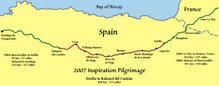
The idea of combining this medieval pilgrimage walk with raising money for the eradication of age-old diseases seems most fitting as we close out our 1500+ kilometre walk that began in April 2004. We walk about six-eight hours a day, averaging about 15 miles. Our walk this spring will take 16 days to go from Estella-Rabanal del Camino, Spain (the portion in red on the adjacent map).

Bienvenidos/as a este camino. Welcome to this journey.