10 April 2007

The long haul


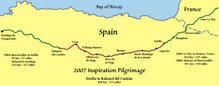
The Cadogan Guide, Northern Spain (Dana Facaros and Michael Pauls), describes the Alteplano thusly:

If the medieval pilgrim survived the storms, cut-throats and wolves at Roncesvalles, the Navarrese who exposed themselves when excited, and the dupers and fleshpots of Burgos, then they faced the dustiest, flattest, hottest and most monotonous landscape in Europe. The idea is that with nothing to look at one becomes introspective and meditative, altogether in a proper state to receive enlightenment. On the other hand, nearly all the route between Burgos and León is off the highways, on paths and lonely backroads where 20th-century intrusions are rare: their straggling hamlets of humble adobe houses, church towers crowned with storks and huge dovecotes (pigeon was the only meat the country folk could afford) evoke the Middle Ages as powerfully as any cathedral (272-73).

That is what we are opting to walk this May. Last year, in late May, we stayed at the home of someone whose father was on the Alteplano. Apparently, it was literally freezing with a stiff wind blowing into his face and he was most cold. So, we don't really know what sort of weather we're going to get.

Everyone says this portion is terrible and we certainly had pity on the pilgrims we saw three years ago as we whizzed by in the train. This go-round, we'll be the poor people slogging away, either roasting or freezing or maybe if we're lucky comfortably.

09 April 2007

Great Easter-tide resource

A companion pilgrim and General Convention Deputy and her husband have produced a collection of essays to take people through Eastertide, called 50 Alleluias. Go mosey on over to their blogsite to sign up for a daily email reflection written by members of their congregation.

In an introduction, Sara writes:

The Alleluia Booklet includes 50 meditations or alleluias, one for each day of the Easter season. Each alleluia is a story, poem, image or other creative piece about resurrection. Some are grand resurrection stories and experiences, some more humble.

Each meditation is written or offered by a member of our community. Many are offered by members of The Garden, Gethsemane Church, our growing church in downtown Minneapolis, Minnesota. Others are offered by members of our larger church community.

At the end of the Easter season, on the Sunday after Pentecost, a day set aside by General Convention for fasting and giving to the Millennium Development Goals we ask for an offering for the Millennium Development Goals and the growth of our mission as a church.

Morning coffee break


Thought for the day

A grand latte can cost $3.65 — have one every morning and that's about $1000 a year. That would provide 200 bed nets that would save children from dying of malaria.

(from the Diocese of Utah's wrap newspaper, Diocesan Dialogue, April 2007, Vol. 18, Issue 4, D4)

05 April 2007

'Love one another as I have loved you.'


Grace Phiri, National Health Coordinator for ERD partner Zambian Anglican Council, conducting an evaluation with the community malaria control team in Fiwila, Zambia. (Copyright ERD 2005)

On this Maundy Thursday, consider well one way in which we can show our love for one another as Jesus commanded us to do.

This information comes from the Episcopal Relief and Development's web site.

Malaria: Prevention and Control

Malaria is a serious and often fatal disease caused by a parasite. It has far-reaching implications for both the health of individuals and for the development of nations.

The World Health Organization estimates that each year 300-500 million cases of malaria occur – 90% of them in Sub-Saharan Africa, where children under the age of five are dying from malaria at a rate of nearly 3,000 each day.

Malaria is a leading cause of death and disease worldwide, especially in developing countries, and kills 1 million people each year, with most deaths being vulnerable young children. In Africa, malaria causes approximately 20% of all child deaths.

Because malaria causes so much illness and death, the disease is a great drain on many national economies. It costs Africa US$10-12 billion every year in gross domestic product even though it could be controlled for a fraction of that sum. Since many countries with malaria are already among the poorer nations, the disease maintains a vicious cycle of disease and poverty.

ERD is working with partners in malaria-affected countries in Sub-Saharan Africa to:

* Educate communities about malaria.

* Provide long-lasting insecticide treated bed nets and effective drug therapies. Ninety thousand people have been positively impacted by these five-year malaria nets.

* Create sustainable systems of malaria prevention within communities through local clergy and community leaders

03 April 2007

Of mountains, literal and figurative


If one is lucky, one gets to see the Pyrenees the day that one crosses from France to Spain. We saw them for many days before walking over them — about ten days before we actually crossed over. We were walking along a ridge that led into Lectoure, and I looked to my left, south, and gasped. 'What is it?' 'It's the Pyrenees!' They were still so far off, it was hard to believe that eventually we'd get up close.

Two days before we hiked over them, we got a good glimpse of them from the Chapel of Soyarza. The mountains in that region of the Basque country are not super high but they still are impressive. Even the day that we walked into Saint-Jean-Pied-de-Port, we could see them and from our room at the bed and breakfast where we spent two nights they were there.

But not the next day.

That often is how it seems with long sought-after goals. They appear to be clear for a while and then they disappear into fog and confusion.

How long has it been that the world has been talking about HIV/AIDS? The US dragged its feet forever on it… Randy Shilt's book, And the Band Played On, tells that story in heart-breaking detail. And that book came out twenty years ago!!! (The pages of my copy are yellowed with age.) We're still muddling around with prevention of HIV/AIDS (MDG #6).

Google HIV/AIDS and you'll come up with 54.600.000 hits.

For starters, though, if you want more information, go to the UNAIDS website.

This pandemic is a true mountain to climb, the path is not always clear, and we still have a long, long way to go.

02 April 2007

For what are we walking?


Insecticide-treated mosquito nets (quoted from Roll Back Malaria.org) [ITNs]

ITNs are designed in various shapes, colours and sizes to appeal to local tastes and meet local needs.

Most malaria-carrying mosquitoes bite at night. Mosquito nets, if properly used and maintained, can provide a physical barrier to hungry mosquitoes. If treated with insecticide, the effectiveness of nets is greatly improved, generating a chemical halo that extends beyond the mosquito net itself. This tends to repel or deter mosquitoes from biting or shorten the mosquito's life span so that [it] cannot transmit malaria infection.

Trials of insecticide-treated nets (ITNs) in the 1980s and 1990s showed that ITNs reduced deaths in young children by an average of 20%. Unfortunately, ITNs can be expensive for families at risk of malaria, who are among the poorest in the world, and cost is not the only barrier to their effective use. Often people who are unfamiliar with ITNs, or who are not in the habit of using them, need to be convinced of their usefulness and persuaded to re-treat the nets with insecticide on a regular basis.

In some areas where mosquito nets are already widely used, it has been estimated that less than 5% are re-treated to achieve their expected impact. WHO has worked with mosquito net and insecticide manufacturers to make re-treatment as simple as possible. However, the best hope lies with newly developed, long-lasting treated nets which may retain their insecticidal properties for four to five years the life span of the net thus making retreatment unnecessary.

One of the targets set at the Abuja Summit in April 2000 was to have 60% of populations at risk sleeping under ITNs by 2005. This will require 32 million mosquito nets and a similar number of insecticide re-treatments each year. To achieve this, much work still needs to be done to make ITNs affordable, widely available, and most importantly, appealing to the consumer. A variety of different approaches are being taken to promote ITN use, reduce their cost and ensure their quality:

* Social marketing schemes, health education campaigns and the development of a 'net culture' through promotion and publicity will all play their part in creating the necessary demand.

* In the Abuja Declaration, African governments committed themselves to reduce or eliminate the tariffs and taxes imposed on mosquito nets, netting materials and insecticides, in order to help lower retail prices. Almost 20 countries have reduced or waived such taxes and tariffs since the summit.

* Countries are also working to encourage the development of local industries and competition among them by ensuring private sector investment in manufacturing and importing mosquito nets.

* Further government action in the form of targeted subsidies, or subsidy schemes, is needed to bring ITN prices down to a level affordable to the poorest families.

* Since many mosquito nets currently in use have been distributed by NGOs or other organizations, WHO has recently drawn up a set of standard specifications for netting materials to make the procurement and quality control of ITNs easier.

* The Strategic Framework for Coordinated National Action for Scaling-up Insecticide-treated Netting Programmes in Africa (WHO/CDS/RBM/2002.42) reviews some of the generic issues frequently encountered in Africa south of the Sahara, during the integration of public and private sector activities, including issues of financing and distribution, and how limited public sector resources can be best used to provide the maximum possible long-term health benefits.

+

The money we will raise will go to Episcopal Relief and Development's Inspiration Fund. More on that in another note, but the short version of what the fund will do is work with Nets for Life to provide nets in Africa (an on-going program), Latin America, the Caribbean and possibly Asia.

01 April 2007

Credentials


It's springtime and life on the Camino is cranking up. I got an email this morning from a woman I have never met but whom I advised last year when she and her sister were preparing to walk the Camino. The writer loved it; the sister did not and so they ended only after a week or so. Now, the writer is returning to finish the Camino without her sister. She loved being in Spain during Holy Week and Easter and so she will spend those days walking. She wrote to those whom she knows who have walked the Camino asking for our prayers. She has them, of course.

Those who undertake the camino as a spiritual exercise or pilgrimage, however they define it, usually get a Credencial at the starting point in Roncesvalles, tucked away in the Pyrenees. Many people actually start walking on the other side of the Pyrenees, in France at Saint-Jean-Pied-de-Port, so they can say they have crossed the mountains. We finished up last year in Spain in Roncesvalles, ending where we had begun walking in 2004. Unfortunately for us, the day we crossed the Pyrenees, it was pea soup so we didn't get to see the vista. Instead, all we saw were sheep in the fog, hearing them before we came upon them.


In any event, the Credencial is the pilgrim's passport to lodging at refugios and aubergues (hostels) along the way. There's a hierarchy of need on the Camino: those who walk get first crack at lodging, then those who bicycle, then those who walk without transporting their belongings on their back and, if there's any room left, those who drive the Camino. In France, one can make reservations; in Spain, usually one can't so that leads to a race to get to the hostels early enough to get a bed and, preferably, not in the middle of a large room. The three of us tend to opt for one-star hotels because it makes doing nightly laundry oh so much more easy.

The pilgrim gets the Credencial stamped with the locales of where one stays. It seems ridiculous to see a bunch of adults asking inn-keepers to stamp their Credencial but there's logic to the madness because one has to have proof of walking the last 100 kms (66 miles) in order to get the coveted Compostela, the certificate that states that the pilgrim has completed the pilgrimage... for spiritual reasons.

We will take the Credencial we started and finished in 2004 and work on the middle chunk. We're doing this all out of order but it doesn't matter; we will have covered every inch of the Camino (and then some).